
Obsession (minus interest), The Invite (to an expensive apartment), Maddie’s Secret (experiment in tech resistance)
Critical dispatches from the 2026 summer megaplex

Obsession dir. Curry Barker
Maybe some of my readers can verify my perception that there’s been an uptick in young people describing relationships in terms of obsession. The phrase “I want a boyfriend/girlfriend/partner who’s obsessed with me” pings on my radar quite a lot these days, maybe somewhere in the ether between Reddit and Love Island. The word has a connotation in that phrase that seems orthogonal to interest — it doesn’t really matter what about you your hypothetical dream partner is obsessed with, just that they are.
This may be what twenty-six year old director Curry Barker is picking up on in his runway box office hit Obsession, a story about Gen-Z attempts at relationships gone wrong. The sort-of-protagonist/sort-of-villain Bear (Michael Johnston) is obsessed with Nikki (Inde Navarette), and wishes for that obsession to be returned. He isn’t visibly interested in Nikki beyond what he wants from her, and neither is the movie, which gives us the bare minimum of her in dimly lit bars and parking lots before Bear’s wish comes literally true.
Obsession is excellent at horror fundamentals, managing to be extremely scary with the bare minimum of supernatural gimmickry. No ghouls, no telekinesis, no crawling on the ceiling. Inde Navarette’s ability to convey menace within the approximate bounds of physical plausibility will be studied for decades. But I can’t think of Obsession as a great movie, because there’s not a single character foothold to stand on outside of the central horror performance — a performance in which a person loses agency completely.
There’s a scene where Nikki (but not 100% Nikki, as she’s under the influence of the Wish) asks Bear, seemingly for the first time in the years that they’ve known each other, what he wants to “do”. Bear cannot answer this question seriously. He semi-ironically responds that it would be fun to be a food critic, but not in a way that even belies interest in food, more so just that he’s seen Ratatouille. Yeah, no wonder he couldn’t get a date without resorting to demonic mind control!
In my own writing, especially when I’m writing in a genre, I increasingly frame character primarily in terms of interest. This is why I say that graduate students (whose whole lives are defined by their interests) are the ultimate protagonists, and I’ll say that again!
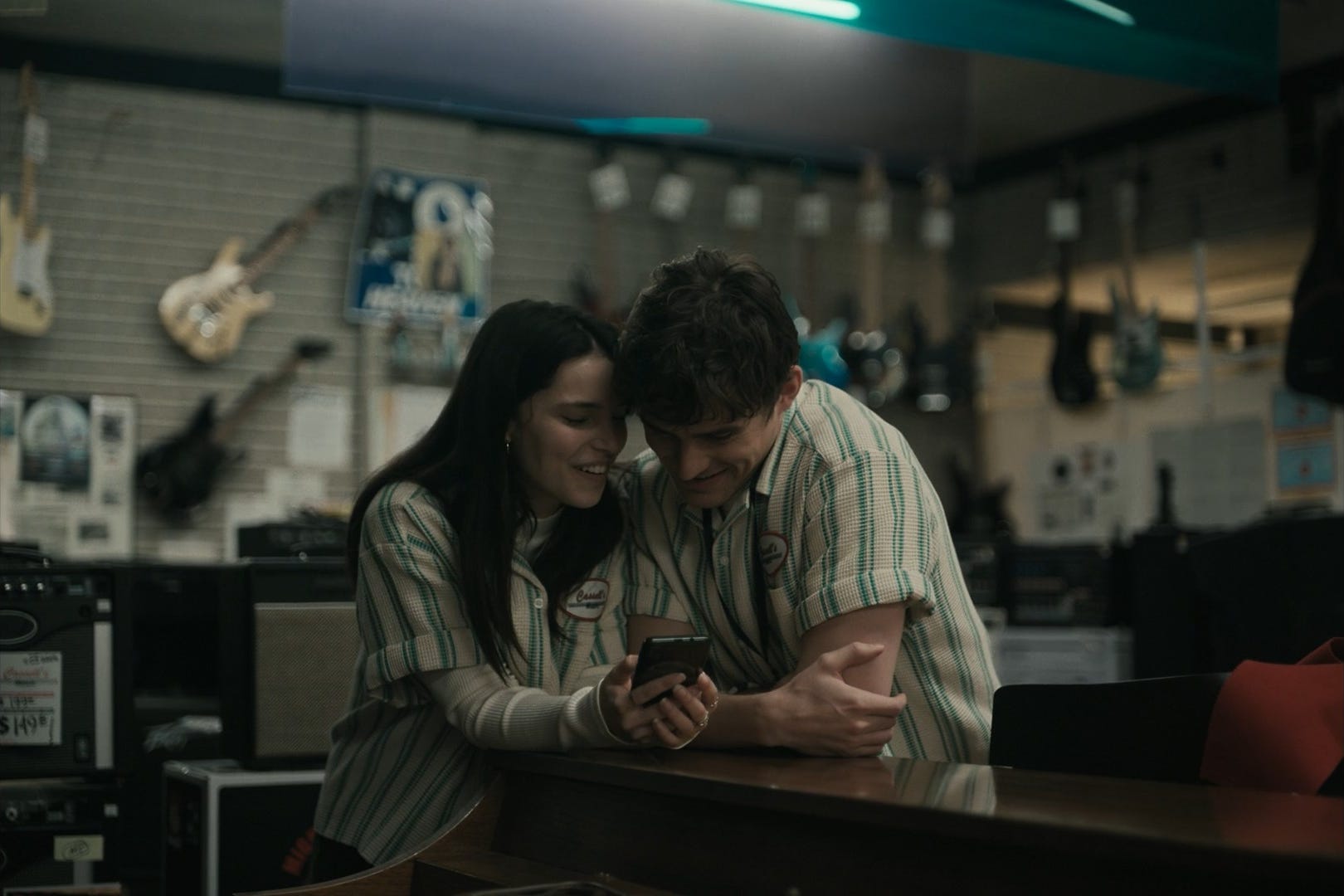
It could be that this relentless flatness of character is Barker’s strategy for conveying the film’s messaging: that relationships without interest can never be anything but obsession, possession and dominance. But I also worry that this is how Gen-Z filmmakers see their peers by default, as living entirely within a techno-media bubble that provides them with nothing but the most surface-level sense of what they can explore and become.
The Invite dir. Olivia Wilde
I found the press-cycle drama surrounding Olivia Wilde’s last directorial effort Don’t Worry Darling (2022) to be really funny, but to me that movie’s actual failure boiled down to a straightforward genre mismatch. Wilde isn’t a sci-fi person, and that’s fine.
Increasingly, I think that very few people are qualified to make sci-fi films. In fact, if I learned anything from Disclosure Day, it’s that not even doing sci-fi successfully in the past means that you can or should do it on a continuing basis.
It therefore makes more sense to view The Invite as a natural progression from Wilde’s first feature, Booksmart (2019). In both films, the directorial hand is very present, especially in the shot choices. But where Booksmart’s gestural style leaned sophomoric and on-the-nose, The Invite dials it into grown-up director realm, using creative framing to wring all the cinematic potential out of four people in an apartment. The progression works thematically, too. Booksmart was about teenagers discovering their relational and sexual selves, and The Invite is about re-negotiating the same thing decades into adulthood.
Movies are facing a crisis of set decoration. There is a profound loss of what friend of the publication Samantha refers to as “the Art of Stuff”. Not to bring up Disclosure Day again, but to prove my point, look at these images from an 80s Spielberg versus a contemporary Spielberg.
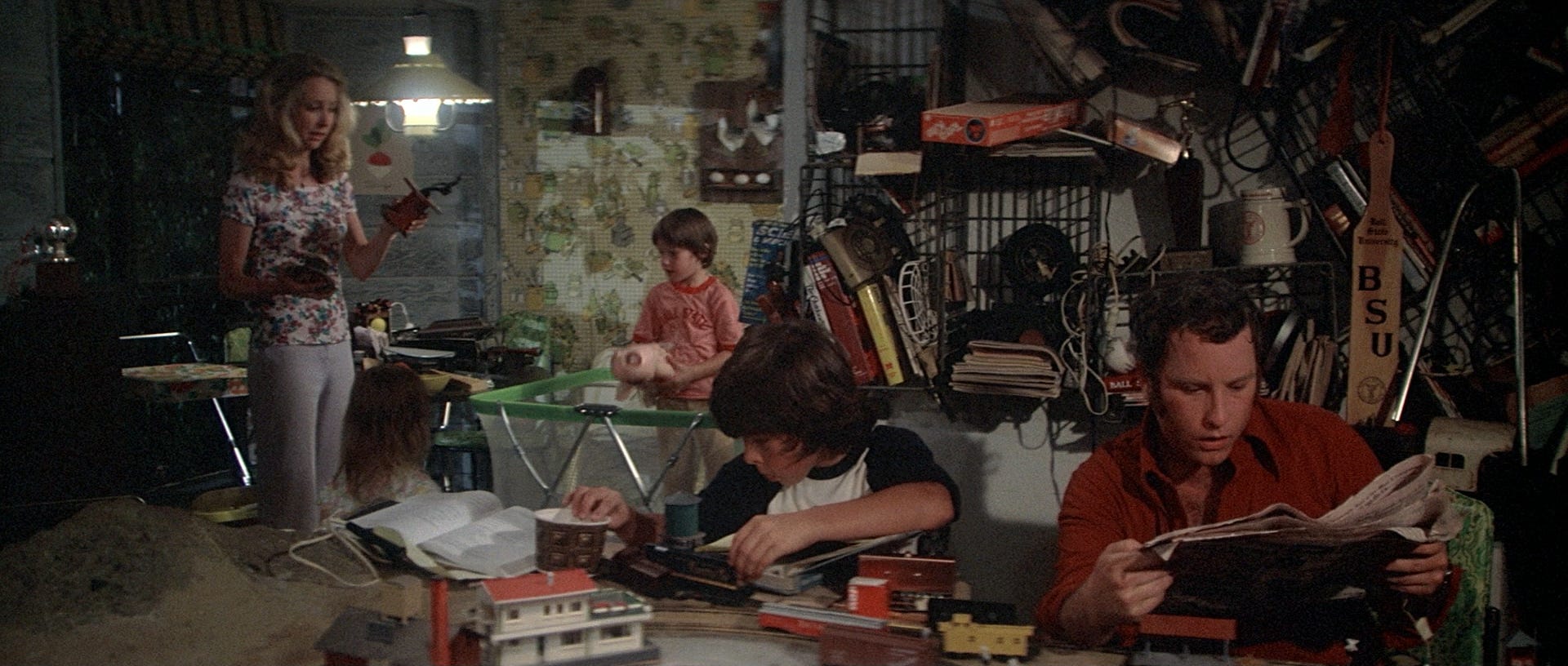
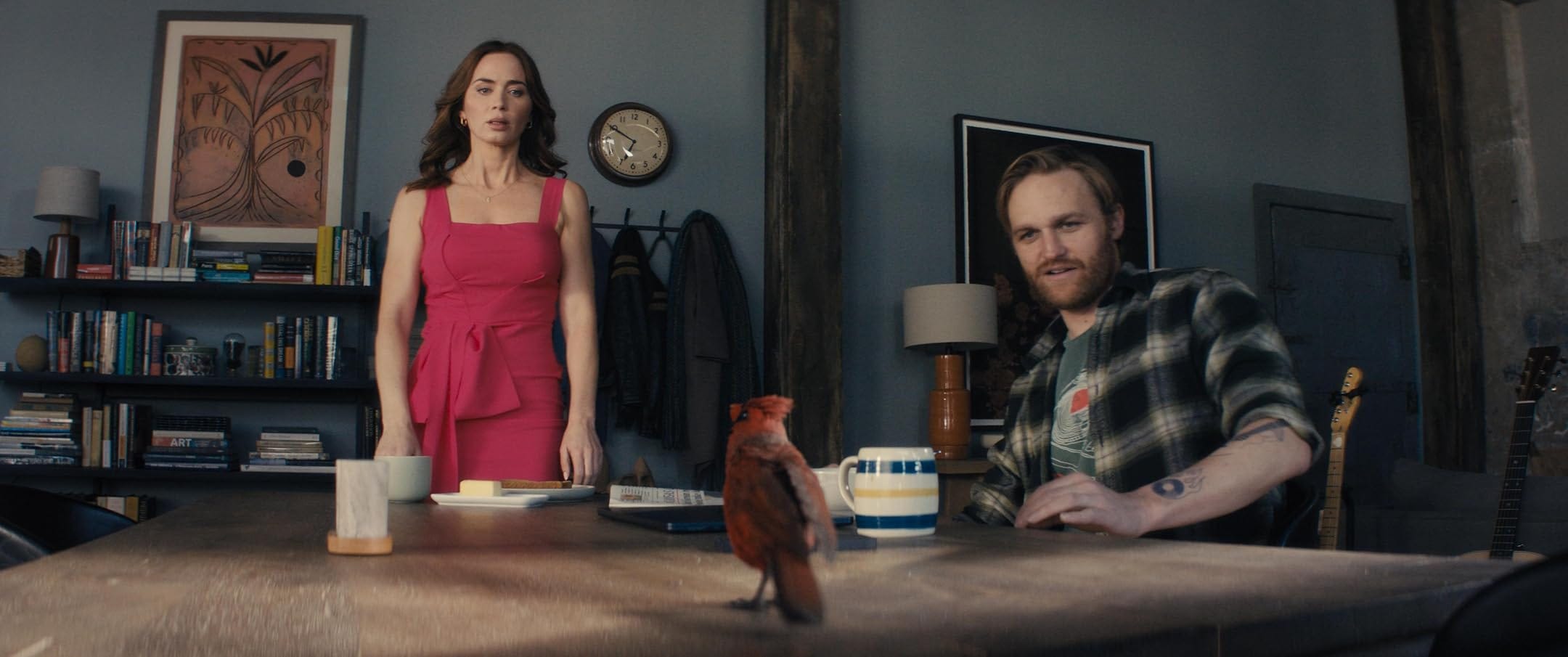
The first image is densely detailed, realistic but also incredibly character-specific and interesting. This second image makes me want to claw my eyes out. I have a hard time wrapping my mind around what appeals to directors and production designers about this stylistically ambiguous, extremely clean Airbnb look that refuses to convey character information.
What grinds my gears about our stuff-hostile design landscape is its inadvertently classist outcomes: it makes characters wealthy by default by thoughtlessly placing them in oppressively clean houses full of coffee table books. These spaces never look like a cleaning service didn’t come through thirty minutes ago.
The first thing I noticed about The Invite was that the set dressing of the San Francisco apartment the entire movie takes place in doesn’t suck. There’s even some significant Art of Stuff happening in the Seth Rogen character’s office. Even still, my guard was up for a narrative about rich people presented without reference to their wealth. But The Invite is not that! The unattainability of the space is confronted early, and explicitly plays into the characters’ mid-adult crises. This gives the film a grounding in setting completely absent from our dislocated Airbnb dramas.
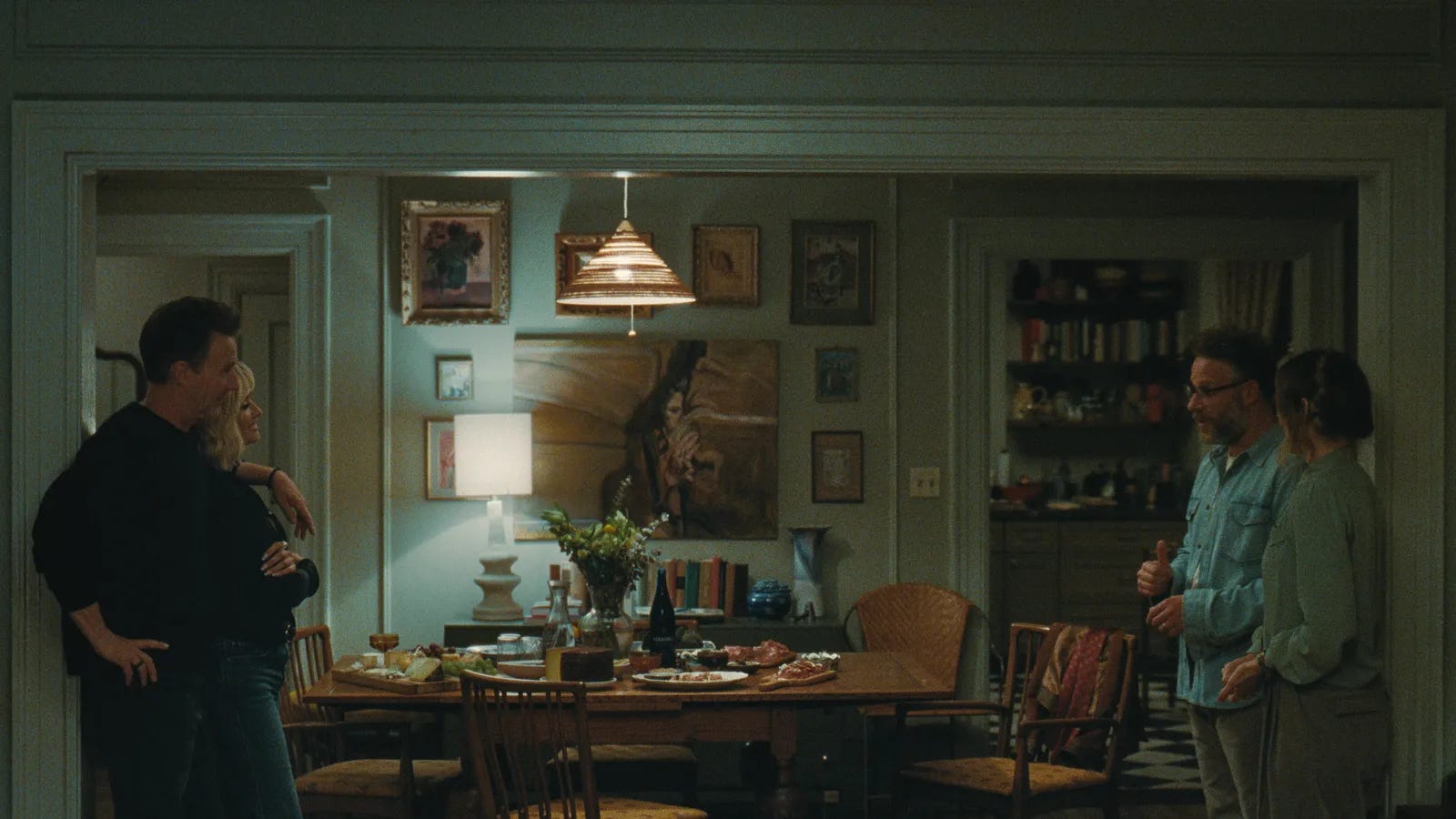
Rashida Jones’ script avoids another of my most hated streamer-era plagues, which is irrelevant small-talk dialogue in the service of (I guess?) realism. The Invite happens in near real-time, Rope-style, and during this time the characters are never not talking about what the movie is about. This makes them come off a little insane, which is fine, because they’re movie characters! The performances more than support the script’s riskier character swings. Wilde in particular is magnetic and funny, making it easy to forget that she’s also directing at the same time. And that is an achievement that will make Don’t Worry Darling, to paraphrase Jack Black in School Of Rock (2003), “a funny little footnote on [her] epic ass”.
Maddie’s Secret dir. John Early
Kate Berlant and John Early are kind of an anomaly in the industry, in that they are comedians whom I find funny. Comedies not entitled Napoleon Dynamite are a hard sell for me, but I went into Maddie’s Secret interested to see how the Berlant/Early sensibility would translate to a feature.
Turns out director/writer John Early’s ambitions go way beyond that — Maddie’s Secret is an out-on-a-limb exercise in tonal balance, relentlessly but reverently parodying the tropes of “bad” movies while also being a good movie itself. Somewhat analogously, Early is a man playing a woman as the title character1, but chooses to make Maddie a dimensional person to be sincerely invested in. As if that wasn’t risky enough, it’s also about bulimia. There’s no way that this precarious mix will “work” for everyone who sees it, but it certainly did work for me, as evidenced by the fact that I couldn’t stop laughing.
I’ve been thinking about ways to portray technologies in film without passively accepting their insidious and pervasive place in our lives. Director Robert Eggers has said the following with regards to contemporary-set films, which he refuses to make:
“…the idea of photographing a cellphone is just death. And to make a contemporary story you have to photograph a cellphone — it’s just how life is — so no.”
I agree with Eggers that photographing a cellphone is very similar to death. But I do not agree that this is “just how life is,” not in actuality, and definitely not in cinema. We do need to tell contemporary stories, and Early does it successfully here.
Set at a viral food content mill called “GourMaybe” Maddie’s Secret satirizes the social-media-based plunder and distortion of what is literally the most basic human activity. The characters engage with social media, but importantly, the camera doesn’t indicate that we should be interested in what’s on their screens. There’s a distinction I can pull out here between screens in the frame as objects of attention, versus characters using screens in a frame that has its own separate visual interest. And all of the shots in Maddie’s Secret go for broke on over-the-top cinema.
Here’s a few examples of the former. And man, you really get what Mr. Eggers is talking about.


It’s hard to even pull an example of the latter from Maddie’s Secret because the screens are rarely static or in focus. Here we have Kate Berlant (and the camera) in motion, announcing that Maddie’s recipe video has “SIX HUNDRED THOUSAND VIEWS.”
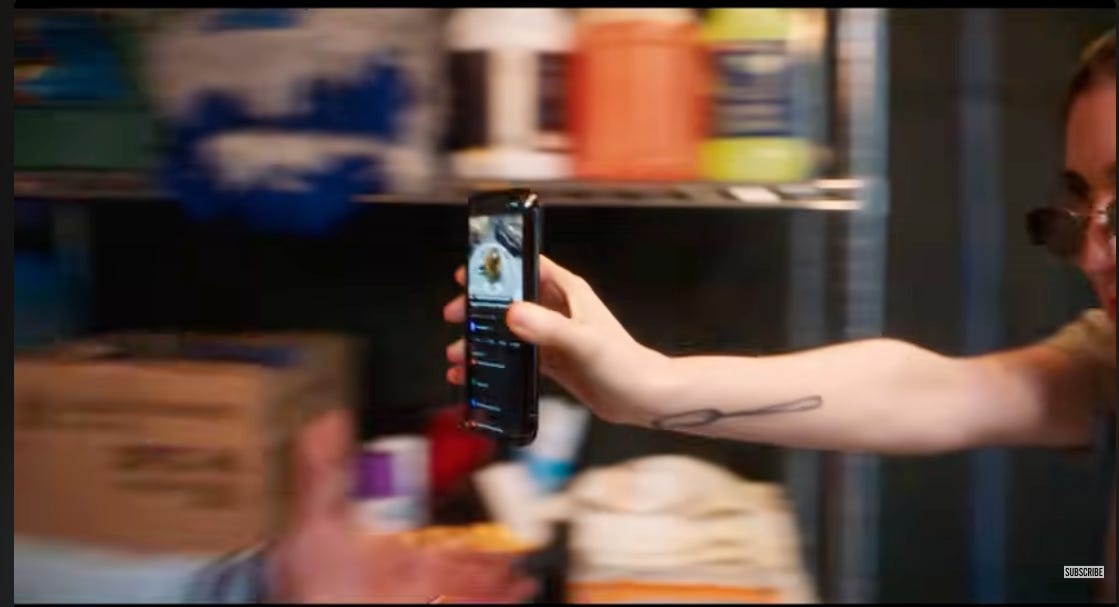
And Maddie’s subsequent (almost in motion) reaction. We never get a good look at the screen here, and we don’t need to!
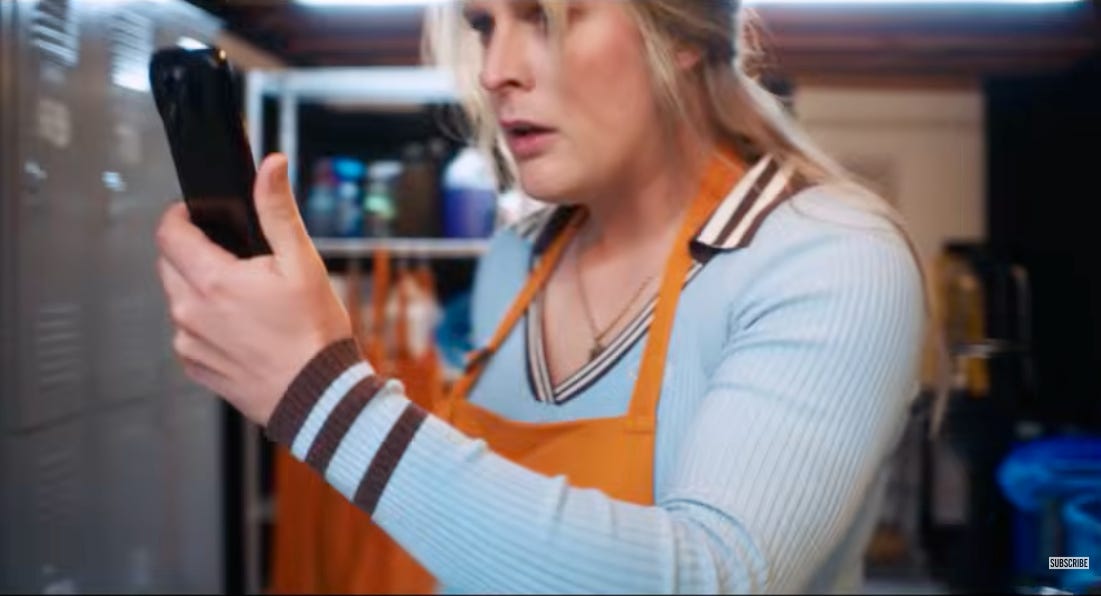
Phones make unfair demands on our attention and lazy filmmaking legitimizes those demands by duplicating the actual experience of looking at them. The great thing about movies, though, is that we get to choose what we see.